

Why Great CEOs Spend Less Time Looking at Data
Business Partner · 14 October 2026 · 5 min read
An executive can spend hours looking at accurate business data and still leave the important decisions untouched. Dashboards, reports and notifications promise greater visibility, but they can also require senior people to do the work of finding what matters. That is a poor use of attention when the business is counting on their judgement.
The purpose of management information is not to keep an executive occupied. It is to make the situation clear enough that the right decision can be made. Better reporting should reduce the need to search, not increase it.
Executives are paid to decide
A chief executive needs to understand financial performance, customers, people and risks. But observation by itself has little value unless it changes understanding or informs action. The difficult work is deciding where to focus, what to stop and which trade-offs the business should accept.
That does not mean executives should ignore the detail. A major investment, an unusual risk or a disputed financial question can justify hours of careful investigation. The difference is that those hours are chosen because the decision deserves them, not because checking systems has become a daily ritual.
There is a useful analogy with instruments in a cockpit. Instruments help a pilot understand conditions and act safely; their purpose is not to become the activity itself. In business, data should support decisions in the same way.
The most informed executive is not necessarily the one who has inspected the most screens. It may be the one who understands the few issues with the greatest consequence.
Great reporting compresses complexity
As an organisation grows, the underlying activity expands. There are more transactions, customers, projects, conversations and exceptions, and it becomes impossible for one person to inspect everything. Good reporting responds by distinguishing patterns from detail.
Transactions are brought together into financial statements, operational events become exceptions and customer activity becomes a picture of relationships and opportunities. The records do not disappear. They are arranged so that a reader can understand the situation without rebuilding it from the beginning.
Compression is not simply shortening a report. A vague summary can be brief while concealing important risk. Responsible compression retains what materially affects judgement, makes the underlying evidence accessible and says when a conclusion cannot safely be drawn.
If several pages can responsibly become one, the concise version may reflect more work rather than less. Someone has decided which details belong in the first reading and which can wait until the executive needs them.
The skill is not hiding information. It is knowing which information earns attention.
Small-business owners carry the analysis
Large companies often have people who prepare that compressed view. Finance teams, department heads and analysts interpret records before a significant issue reaches the chief executive. A smaller business rarely has such a support structure.
Instead, the owner checks the bank, opens accounting software, reviews overdue customers and searches through email or messages for an earlier agreement. The owner may also be responsible for selling, managing staff and settling problems. Each system provides useful information, but none necessarily explains how all the pieces fit together.
This creates an unfortunate imbalance. The person with the least spare time may be doing the most manual information processing. Additional software can worsen the problem if every new tool demands another morning check.
There is an opportunity for business technology to do some of the connecting and prioritising that larger organisations assign to people. That requires evidence-aware summaries and clear decisions about what needs attention. It does not require claiming that every business system is connected or that every external action can already be delegated.
The owner should not have to become the analyst of every ordinary event.
What should reach the top
A useful test for management information is whether it requires a decision, awareness or intervention. If a process is proceeding normally, it usually does not need the same prominence as an exposed obligation. If a customer has changed payment behaviour, that may deserve attention before a long list of routine transactions.
What comes forward should reflect consequence rather than volume. One unresolved customer issue can matter more than a full report of ordinary sales activity. One deadline approaching without preparation can matter more than several measures that have remained stable.
The system must still be honest about its limits. If evidence is old, contradictory or incomplete, a quiet page should not be mistaken for an all-clear. Saying that something is unknown may itself be the most important message of the day.
A well-designed executive view can also support an informed decision not to act. It should distinguish work already being handled from work waiting externally and a matter that genuinely needs the owner's judgement. Otherwise everything becomes another prompt.
Good management information protects the right to leave ordinary things alone.
Looking should lead somewhere
After reading a report, the executive should know what to do next, what to question or why no intervention is required. That might mean reviewing a payment, calling a customer, confirming an earlier decision or preparing for a meeting. The point is not to turn every fact into a task, but to make the consequential next step visible.
Business Partner's Morning Brief is designed around this principle: bring forward supported matters, identify what needs the owner and distinguish it from work being carried. Ask provides a way to examine supported evidence and calculations, while Memory keeps relevant business understanding accessible. These are useful parts of an operating relationship, not a claim of unlimited autonomous execution.
The standard for trust remains demanding. Calculations should show their basis, source documents should have dates and recommendations should allow scrutiny. A prepared message must not be confused with a message sent, and a suggestion must not be confused with a verified outcome.
A concise reading earns its place only if it helps the owner make a better decision. It should make deep inspection possible but not force it into every day. The aim is not a better-informed spectator. It is a more effective decision-maker.
See your own Morning Brief
Send the aged debtors report your accounting system already produces and see who to chase first.
Try it with your reportKeep reading

Your Business Has Cash Hiding in Plain Sight
The money most owners are looking for is already earned. It is sitting in an aged debtors report, waiting for a follow-up nobody had time to send.

Why Small Companies Can Now Think Like Great Ones
The habit of noticing what matters should not depend on having a large management team.
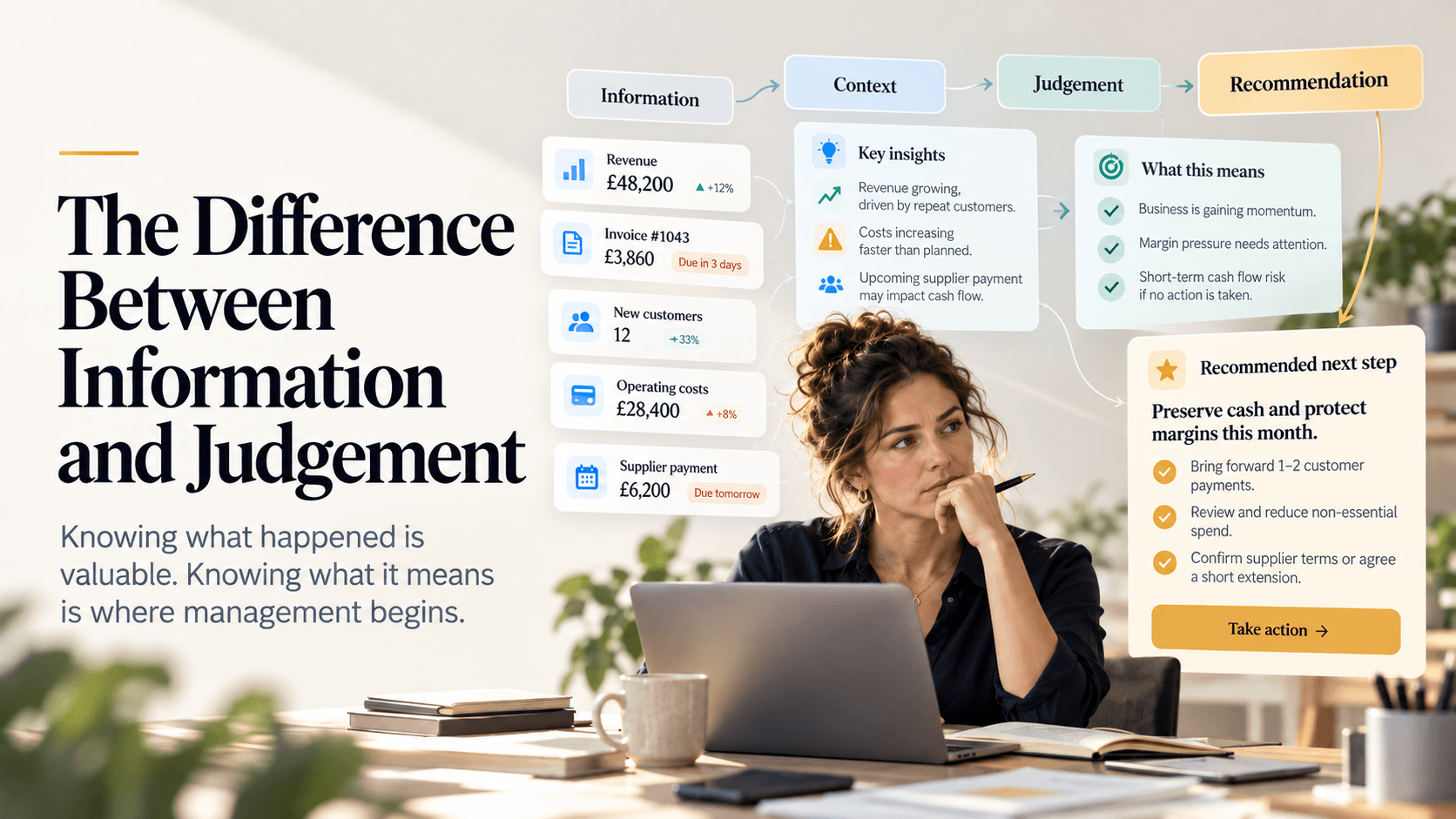
The Difference Between Information and Judgement
Knowing what happened is valuable. Knowing what it means is where management begins.