
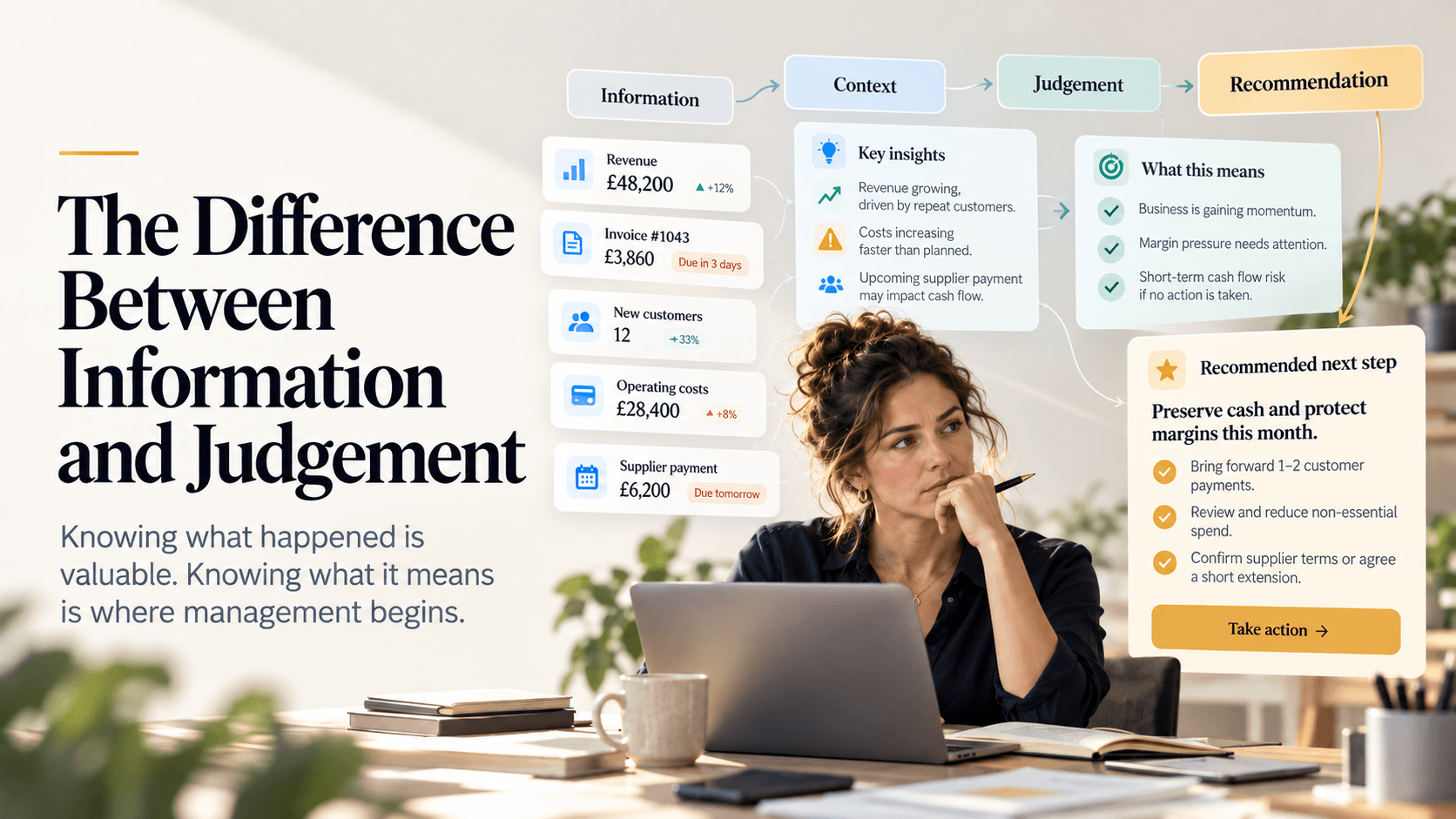
The Difference Between Information and Judgement
Business Partner · 14 October 2026 · 5 min read
Reliable business information is essential, but it can still leave an owner with the most difficult question unanswered. A balance, an overdue invoice or a sales total describes something that happened. It does not necessarily explain whether the result matters or what should be done next.
Consider an outstanding customer balance. Its value may be exact, yet its significance depends on timing, payment history, cash needs and earlier conversations. A number can be precise while the decision around it remains uncertain.
Information tells us what happened
Business systems are generally good at storing transactions and producing reports. They can show customer balances, expenses, invoices and recorded activity in a consistent format. Those facts matter because judgement without evidence can become guesswork.
The limitation appears when several accurate facts point in different directions. A fall in the bank balance may be concerning or may follow an expected annual payment. A rise in receivables may suggest collection pressure or simply reflect a strong trading period.
An isolated figure cannot explain its own context. The owner needs to know what normally happens, what changed and what else is taking place in the business. Looking at more figures can help, but only if the relationships are made clearer.
This is why a report and a decision brief serve different purposes. A report presents the records; a brief identifies the part of those records that deserves interpretation. Both have a place, and neither should pretend to do the other's job.
Facts establish the ground on which judgement can stand. They do not make the judgement for us.
Judgement distinguishes what matters
Two overdue invoices can have the same amount and need different responses. One customer may regularly pay a few days late and have a clear promise in place. Another may have stopped replying after years of reliable payment.
The same applies to spending and sales opportunities. A cost above expectation could reflect investment or waste; a promising enquiry could be attractive or impossible to serve profitably. The owner has to weigh consequence, timing and the wider business rather than treat similar numbers identically.
This work of distinguishing is a defining part of management. It means recognising that an issue can be important without being urgent, and that something urgent may not deserve much executive thought. It also means noticing when the available evidence is not strong enough to support a conclusion.
Technology becomes more useful when it helps make those distinctions visible. It should explain why an item has been brought forward rather than simply place a red badge beside it. The owner should be able to inspect the underlying evidence and challenge the interpretation.
The valuable question is often not what happened, but so what?
Context gives facts their meaning
Context can come from yesterday's figures, a customer's usual pattern, an earlier decision or a deadline approaching. Sometimes it comes from a conversation not yet recorded in any system. A good reading of the business needs to make room for both documented evidence and what remains unknown.
Suppose a customer appears unusually late. The accounting record may be correct, but the owner may know that a payment arrangement was agreed by telephone. Until that conversation is recorded and assessed, it would be careless to describe the customer as refusing to pay.
There is a second risk in combining information from different periods. A current debtor report and an old income statement can make a calculation look authoritative even when the dates do not support comparison. Missing source dates, mismatched periods and incomplete records are not cosmetic defects.
That is why reliable management information must show where its interpretation came from. Sources and dates should be easy to inspect, and uncertainty should be disclosed at the point where it changes the conclusion. Trust grows when the system is willing to say what it cannot establish.
Context is what turns a correct observation into a useful understanding.
From understanding to a recommendation
There is a further step beyond deciding that something matters. A recommendation connects the evidence to a sensible next move, taking account of consequence and what the owner is authorised or willing to do. It should be specific enough to be useful without pretending the decision is automatic.
A customer may owe a material amount, be unusually late and have stopped responding. A reasonable recommendation might be to review the latest conversation and contact the customer before pursuing smaller accounts. That is more helpful than repeating the outstanding balance alone.
But recommendations also require restraint. If a payment has been promised, a dispute remains unresolved or a bank-detail change cannot be independently confirmed, the appropriate next step may be to verify rather than to send or pay. Doing nothing until evidence improves can be a considered decision.
Business Partner can help an owner inspect supported evidence and work through a next step. Its Assisted Execution approach distinguishes prepared messages and owner-reported activity from verified delivery or outcomes. A recommendation is not proof that the suggested action occurred.
Good recommendations explain the next move while preserving the owner's judgement.
The strength of an honest answer
As software becomes better at retrieving and summarising information, it is tempting to value confident answers above careful ones. Yet exact figures can create a false sense of certainty if the record is stale or the relevant conversation is missing. A cautious explanation may be more commercially valuable than a polished but unsupported conclusion.
Useful decision support should separate what is known, what appears likely and what still needs confirmation. It should also explain why the missing piece matters. That allows the owner to contribute knowledge the system does not have instead of being asked to trust an unexplained answer.
Experienced owners already do much of this instinctively. They recognise patterns, notice changes in a customer's behaviour and weigh operational consequences that no isolated metric captures. Technology should reduce the effort of assembling that context, not replace experience with artificial certainty.
The evidence remains available and the responsibility for consequential decisions remains clear. Information helps an owner understand the business, but understanding becomes valuable when it changes how the business is run. Judgement begins where the report ends.
See your own Morning Brief
Send the aged debtors report your accounting system already produces and see who to chase first.
Try it with your reportKeep reading

Every Business Owner Needs a Thinking Partner
More information does not solve the shortage of attention. Better judgement about what matters might.

Why Great CEOs Spend Less Time Looking at Data
The purpose of management information is not to occupy the executive. It is to free the executive to decide.

Why Small Companies Can Now Think Like Great Ones
The habit of noticing what matters should not depend on having a large management team.